
Perspectives on Scotland’s third sector impact
By Jane Cullingworth
The impact event
On June 11 2025, over 70 people from a diversity of backgrounds came together to talk third sector impact at the University of Glasgow. The leadership for the day was provided by VSSN, working with an enthusiastic steering group of representatives from the Scottish Third Sector Research Forum, Youth Link Scotland (The National Agency for Youth Work in Scotland), Volunteer Scotland, Scottish Council for Voluntary Organisations and the University of Glasgow. This highly interactive event attracted people from the third sector and academia to explore the:
- impact of volunteering and the third sector
- role and impact of researchers doing work in the sector.
From our very first “save the date” email, we knew we were tapping into an important topic. Spaces filled up quickly and we had to maintain a waiting list!
Measuring the impact of volunteering and the third sector
The morning sessions set the stage. Bethany Sikes (Volunteer Scotland) presented their recent report measuring the social value of weekly formal volunteering, estimated to be worth £530 million annually across Scotland, and a whopping £2.3 billion when combined with economic value. Gary Walsh (Evaluation Support Scotland) shared five key principles to help organisations demonstrate impact, and Alasdair Rutherford (University of Stirling) presented on the challenges of measuring third sector impact, describing it as the ‘holy grail’ of quantification!
People discussed both the benefits and challenges of measuring impact in small groups. The observation that, ‘Not everything that counts is counted, and not everything that is counted counts’ perfectly captured one of the perennial challenges of trying to measure impact. Suggestions for good practice included embedded, bottom-up and co-produced approaches.
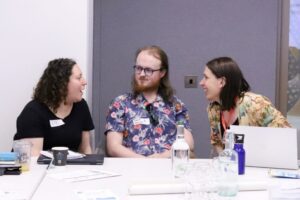
Image: small group discussion about third sector impact
Adam Lang (Carnegie UK) gave the keynote address about the role of civil society in helping to address shared challenges across the UK. Identifying civil society organisations as “trusted intermediaries between citizens and the state”, he encouraged and challenged us to BE BRAVE in our work with communities. Adam shared this cartoon that beautifully reflects the complexity in which we work (reproduced with permission, www.Businessillustrator.com).

Image: complexity outside linear cube
Meet the sector, meet the researcher
The interactive afternoon began with the opportunity to meet researchers from a range of backgrounds. Using the carousel method, people moved between the following eight stations:
- Working with youth peer researchers (Young volunteers from YouthLink, supported by Liz Green)
- Relational ethics and researching communities (Dr Marisa De Andrade, University of Edinburgh)
- How the sector can promote evidence-based policymaking (Carol Young, Coalition for Racial Equality and Rights)
- Research with LGBTQ+ young people (Dr Mathew Wilkie, LGBT Youth Scotland)
- Researching how social entrepreneurship impacts inequalities (Professor Artur Steiner, Glasgow Caledonian University)
- Collaboration ‘in between’ university and third sector space (Dr Paula Karlsson Brown, University of Glasgow)
- Linking into the wider UK research network of VSSN (Dr Jurgen Grotz and Dr Meg Wright, VSSN)
- SCVO’s Third Sector Tracker update (Ilse Mackinnon and Steve Grozier, SCVO)
For many, this session was a real highlight.
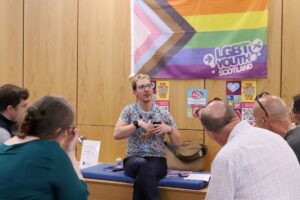
Image: Dr Mathew Wilkie of LGBT Youth Scotland leading one of the ‘meet the sector, meet the researcher’ stations
Research with small community and place-based organisations
Our final session was facilitated by Lewis Hou (Science Ceilidh) with short lightning talks. To help us reflect on our role as researchers, the place of communities and the politics of evidence, speakers set us provocations:
- Why should communities carry out their own research? (Andrew Paterson, Scottish Community Development Centre)
-
- What needs to change to ensure co-creative research methods are valued ways of generating knowledge and evidence? (Emma Davidson, University of Edinburgh)
- Does research distract us from action? (Sarah Ward, University of Edinburgh)
- How can communities set the terms around ethics better? (Lewis)
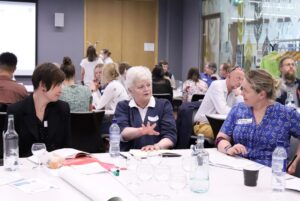
Image: Discussing the speaker provocations
Key takeaways
The day was engaging, exhilarating and exhausting. Judging by how many people were still in the room at the end of day, we had impact! Throughout the day the third sector shone – a sector alive, powerful and influential. What did we learn? Individual relationships are fundamental to our work and to systems change. Partnerships are also essential – between academia and third sector researchers, as well as between third sector organisations and communities. Impact can be demonstrated in many ways, including creative approaches. Sometimes a personal story is more powerful than statistics. As they say, a picture is worth a thousand words. Measuring impact is notoriously difficult and numbers can be contentious. Learning from what works is essential as is learning from what doesn’t work – and we must track our learnings. Finally, as researchers, regardless of where we are based, we must be reflective in our work and always attuned to issues of power.
Feedback from participants was very positive with many commenting on how they appreciated the interactivity of the day, as reflected by this comment:
“The day was facilitated in a way which prompted engagement and knowledge sharing. This was a bit different to usual conferences, and an excellent aspect of the conference.”
Perhaps we can take some of the learning from this event to make traditional academic conferences more impactful!
Acknowledgements
We are very grateful to the ESRC Impact Acceleration Account at the University of Glasgow and VSSN for funding the event.
References
Volunteer Scotland (2025) The Social Value of Volunteering in Scotland www.volunteerscotland.net/news/the-social-value-of-volunteering-in-scotland
